

The growth tax
There is a specific stage in an SME’s growth where success starts to feel wildly uncomfortable. You have more customers than ever. You have more revenue. You have hired more staff. On paper, you are winning.
But in the office, everything feels harder. Your operations manager is stressed. Your sales team is complaining about admin. Your finance team is working late to reconcile invoices.
Why? Because the systems that worked perfectly when you were a team of three are broken now that you are a team of thirty. You are paying the "Growth Tax." This is the hidden cost of running a business on disconnected systems, and it is likely the single biggest drag on your profitability right now.
The swivel-chair epidemic
The most visible symptom of disconnected systems is what I call "Swivel-Chair Integration."
This happens when you have two pieces of software that don’t talk to each other, say your eCommerce website and your accounting software. To bridge the gap, you pay a human being to sit in the middle.
They look at one screen (the order email), swivel their chair, and type the exact same information into another screen (Xero or Sage). It seems harmless. It only takes two minutes, right? But let’s do the maths.
If you process 20 orders a day, that is 40 minutes of typing. Over a week, that is more than three hours. Over a year, that is 160 hours, essentially a full working month, spent doing nothing but acting as a human photocopier.
And that is just one process. Add in the time spent manually updating your CRM, manually creating shipping labels, and manually chasing invoices, and you might find that 20-30% of your payroll is being spent on data entry.
The accuracy penalty
The cost of time is bad enough. The cost of errors is worse.
Humans are terrible at data entry. We get tired. We get bored. We get distracted. Research suggests a standard human error rate of around 1% for simple data tasks.
In a business processing 500 orders a month, that is five botched orders every single month. That is five customers receiving the wrong item. Five customers being billed the wrong amount. Five shipping labels with the wrong address.
The cost of fixing these errors is exponential. It costs £5 to ship a box. It costs £50 to fix a mistake, shipping the return, shipping the replacement, the admin time to process the credit note, and the potential loss of the customer’s lifetime value.
When you integrate your systems, you replace the tired human with an API. APIs don’t get bored. They don’t make typos. They don’t mistype an SKU because they haven’t had their coffee yet. They move data with 100% fidelity, every single time.
The opportunity cost
Then there is the cost you don’t see, the opportunity cost. What could your team be doing if they weren’t typing data into spreadsheets?
Your sales team could be selling. Your operations manager could be negotiating better rates with suppliers. Your customer service team could be proactively calling clients to upsell.
We worked with a client recently who had a full-time employee dedicated to "Order Processing." In reality, her job was copying data from emails into Salesforce. We built an automation that did her entire day’s work in 4 seconds.
We didn’t fire her. We moved her into Account Management. In her first year, she generated £150,000 in new revenue from existing clients, revenue that simply wouldn’t have existed if she was still stuck doing data entry.
That is the true cost of disconnected systems. It’s not just the time you lose; it’s the value you fail to create.
Data silos kill decision making
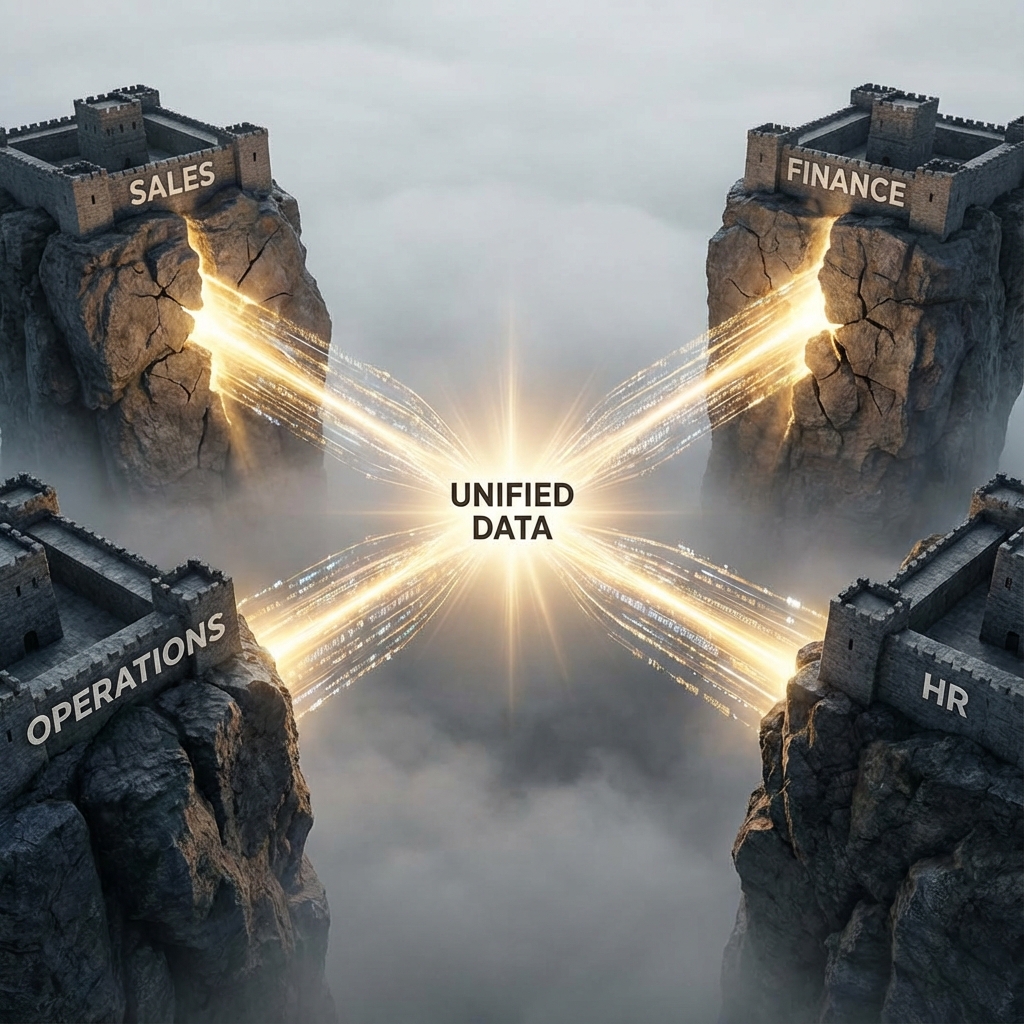
Finally, there is the strategic cost. When your systems are disconnected, your data lives in silos. Your sales data is in the CRM. Your financial data is in Sage. Your inventory data is in a spreadsheet.
This means you never have a true, single view of your business. You can’t answer simple questions like "Which marketing channel brings in the most profitable customers?" because the marketing data and the profit data live on different islands.
You end up running your business on gut feel and lag indicators. You find out you had a bad month three weeks after the month ends, when the accountant finally reconciles the books.
Connected systems give you a dashboard. They give you real-time visibility. They allow you to make decisions based on what is happening today, not what happened last month.
Conclusion
You cannot scale manual work. You can hire more people, but that eats your margin and increases your management overhead. The only way to scale profitability is to connect your systems.
Look at your workflows today. Wherever you see a human being acting as a bridge between two pieces of software, you have a leak in your business. Plug the leak.
TL;DR
- The Tax: Disconnected systems create a "Growth Tax" that makes scaling harder and less profitable.
- Swivel Chair: Paying staff to manually copy-paste data is a waste of human potential.
- Error Rate: Humans make typos. APIs don’t. Integration is an insurance policy against mistakes.
- Opportunity: Liberate your team from admin so they can focus on high-value work like selling and strategy.
- Visibility: You can’t steer a ship if you can’t see the instruments. Connected systems give you real-time data.
Is your team drowning in admin?
We help growing SMEs connect their tools and banish manual data entry. Let’s automate the boring stuff so you can focus on growth.